
Prospects scattered across channels
Leads arrive from Instagram, WhatsApp, web forms, trade shows, and referrals — then end up in each salesperson's personal notes. With no single list, prospects easily go unfollowed and nobody notices.
 Integrated Odoo Module
Track prospects, win more opportunities.
Manage your entire sales process — from the first incoming lead to a closed, paid deal — in one visual pipeline your whole team can monitor in real time. No more prospects lost in the gaps between WhatsApp, email, and spreadsheets. Everyone — from reps to managers to leadership — works from the same, always-current customer data, whether in the office or in the field.
Most sales teams still run their process across three places at once: WhatsApp chats, an email inbox, and a spreadsheet that gets updated whenever someone remembers. While revenue is small, this feels good enough. But as the number of prospects grows and the team expands, cracks appear — hot leads are forgotten, quotes go out late, and leadership has no clear picture of how many deals will actually close this month. The result isn't just messy admin; it's revenue quietly leaking away. What makes it dangerous is that the leak rarely shows up in a monthly report — it hides as prospects that were never contacted again and customers who quietly moved to a competitor. The bigger the team, the harder it becomes to ensure every prospect is handled to the same standard, and the cost of bringing in new leads keeps rising while old ones go to waste. Here are the most common problems we see before a team moves to a centralized CRM.
Leads arrive from Instagram, WhatsApp, web forms, trade shows, and referrals — then end up in each salesperson's personal notes. With no single list, prospects easily go unfollowed and nobody notices.
Without automatic reminders, salespeople rely on memory. A prospect promised a call on Thursday sinks under a pile of chats. Most deals need several touches to close — and one missed follow-up often means a lost sale.
A simple question like how much value is in the negotiation stage takes hours of manual tallying. Management struggles to forecast revenue, allocate the team, or see where deals get stuck.
When a salesperson leaves or takes leave, the customer's communication history goes with them. The replacement starts from zero, the customer repeats the same story, and the company looks less professional.
Quotes are still copy-pasted from old Word or Excel templates. Prices can be wrong, formats differ between people, and approvals drag on. A prospect who waits too long simply moves to a competitor who responds faster.
Targets are set on gut feel, not data. Without per-stage probability and conversion history, it's hard to plan cash flow, stock, or hiring with confidence.
Building a weekly sales report means copying data from scattered files and chats. It's slow, error-prone, and by the time it's done the numbers are often already stale because the situation on the ground has moved.
Without centralized data, it's hard to know who is productive, which stage stalls most often, or which campaigns produce the best prospects. Coaching then rests on assumptions instead of traceable facts.
Customers who have already bought are the cheapest source of new sales, but without a system nothing prompts the team to offer more or renew. Repeat-order potential simply evaporates.
Contacts sit on many personal phones with no backup. When a device is lost or an employee leaves, the data goes with it, and there's no control over who can access what — a serious risk to the company's most important asset: its own customers.
Odoo CRM brings every sales activity into one shared system. Every prospect — whatever its source — flows automatically into a single pipeline. Every call, email, note, and quote is logged on the same opportunity card, so anyone on the team can pick up without losing context. Activity reminders make sure no follow-up ever drops, while real-time dashboards give leadership a full picture at any moment with no manual tallying. Most importantly, the CRM is unified with Odoo's Sales, Invoicing, and Inventory modules — the moment a deal closes, the quote becomes a sales order, invoice, and delivery with no re-entry. There is no more data typed twice between departments, and no more mismatch between what sales records and what finance books. Because everything lives in one database, decisions are made on the same, always-current information. Here are the core capabilities.
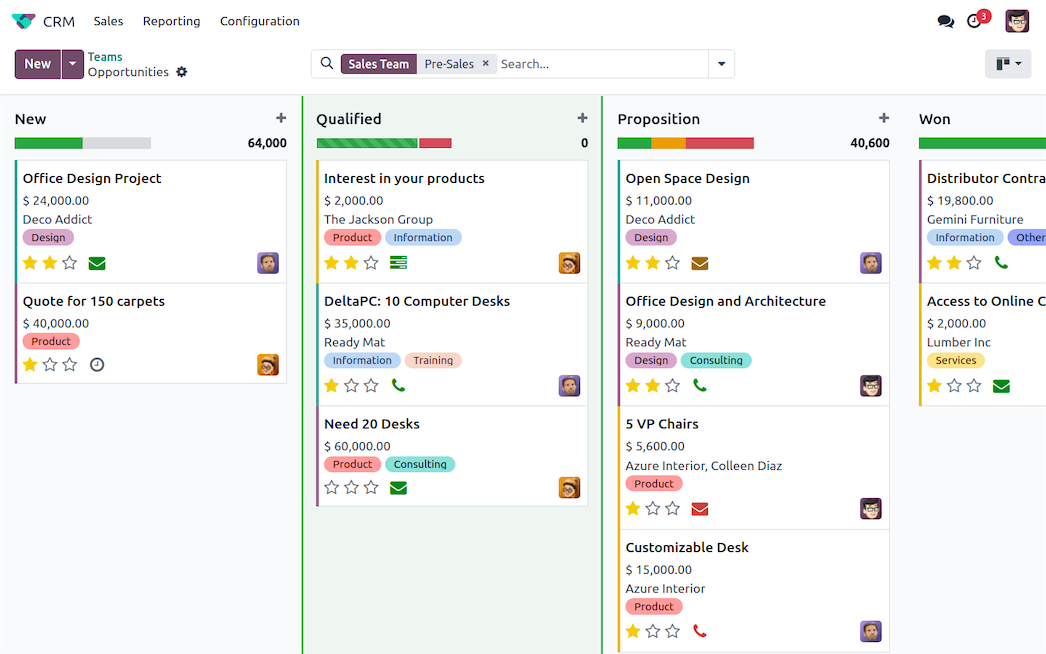
See every opportunity on a clear Kanban board by stage. Drag a card from Qualification to Proposal to Won with a simple gesture. Each column shows the count and total deal value, so pipeline health reads at a glance.
Odoo scores each prospect on data such as source, industry, and engagement, then ranks them automatically. The team focuses first on high-probability prospects instead of wasting time on leads that aren't ready.
Schedule calls, meetings, and follow-ups straight from the opportunity card. The system reminds you of every activity due, so no promise is forgotten and each prospect is touched at the right time.
Send and receive email inside Odoo, log calls, and integrate WhatsApp. Every conversation sticks to the customer card, so the history stays intact and accessible to the whole team.
Build tidy quotes from the product catalog in minutes, send them as an online link the customer can view, and collect approval via electronic signature — speeding up closing with no document back-and-forth.
Dashboards show conversion by stage, per-rep performance, and revenue projections based on probability. Leadership decides on data, not guesses, and can export reports anytime without troubling the team.
Build automatic rules: send a welcome email, schedule a follow-up, or move an opportunity between stages when conditions are met. The team cuts repetitive work and focuses on conversations that actually convert.
Run multiple sales teams, branches, or territories in one system, with targets, pipelines, and reports that can be split or combined to match your org structure — still one source of data.
Customers can view quotes, approve them, and track orders through an online portal. Communication becomes transparent and cuts down on repeat questions by phone or chat.
Move contacts and history from Excel or a legacy system via a cleanly mapped bulk import, so you start with a complete, tidy database — not from zero.
One of Odoo's biggest strengths is a workflow that connects end to end. Here is a prospect's journey through the system — from first contact to paying customer — all in one place, with no app-switching or double entry. Each stage is designed so information flows forward automatically, so the team doesn't spend time retyping or hunting for scattered data. The flow can be tailored to your actual business process — stage names, rules, and automation follow the way your team works, not the other way around.
Prospects from your website form, email campaigns, WhatsApp, or a trade-show list are created as leads in Odoo — no manual entry. Each lead carries its source, so you know which channels are most productive.
The system assigns an initial score, and the team fills in the prospect's needs, budget, and timeline. Qualified leads are promoted to opportunities and enter the sales pipeline.
Opportunities are routed automatically to the right rep by territory or product. The first activity — an intro call or meeting — is scheduled immediately, complete with reminders.
Every email, call, and meeting note is recorded on the opportunity card. The team keeps momentum, while managers monitor progress without asking one by one.
The rep builds the quote straight from the opportunity, sends it as an interactive online page, and revises as needed. The customer can approve and sign electronically.
Once approved, the quote turns into a sales order automatically. Data flows to Inventory for delivery and to Accounting for invoicing — with nothing retyped.
Won and lost deals are fully recorded. Dashboards show conversion, sales cycle, and loss reasons, so the team keeps improving its strategy each cycle.
Once a customer is active, the team stays connected through the CRM for cross-sell, up-sell, and renewals. New opportunities from existing customers are logged in the same pipeline, so customer lifetime value keeps growing without hunting for new leads from scratch.
This page centers on the Odoo CRM app, but its real power shows when it works alongside other Odoo apps in one database. You don't need to adopt everything at once — we usually start with what's most pressing, then add modules as needs grow, with no re-migration. Here are the apps we most often implement together with CRM to form a complete sales flow, from first prospect to paid invoice.
The core of lead and pipeline management: leads, opportunities, activities, scoring, and sales reporting.
Turns opportunities into quotations and sales orders, and manages the product catalog, pricing, discounts, and payment terms.
Mass email campaigns and automated nurturing to keep not-yet-ready prospects warm until they mature.
Legally valid e-signatures for quotes and contracts, speeding up approval with no print-and-scan.
Automatic invoices from sales orders, payment tracking, and clean revenue recognition.
Real-time sales reports and KPIs that can be customized per role, from rep to director.
Contact forms and landing pages that create leads directly in the CRM, plus live chat to capture interested visitors in real time.
Official WhatsApp integration to send message templates, order notifications, and follow up prospects straight from inside Odoo.
Illustrative: a B2B services firm with an 8-person sales team
A B2B services firm relied on WhatsApp and a shared spreadsheet to manage hundreds of prospects a month. Each rep kept their own contacts, so when someone resigned, dozens of prospects effectively vanished along with the data on their phone. Leadership couldn't forecast revenue with no central pipeline, and quotes often went out late because they had to be assembled by hand from old templates whose formats differed from person to person. Marketing diligently generated leads from campaigns, but many were never followed up because there was no clear handover mechanism. As a result, conversion stayed flat even as lead volume kept rising, and the cost of acquiring each customer crept up.
We implemented Odoo CRM and Sales as a single source of truth for the whole team. The website form, live chat, and WhatsApp were connected so every lead arrives automatically with its source attached. The pipeline was split into stages that mirror their real process, and automatic assignment rules route each lead to the right rep. Quote templates were standardized so offers can be built and sent in minutes, complete with e-signature. Activity reminders ensure no prospect is forgotten, while dashboards give leadership a daily pipeline view with no need to request a recap. Before go-live, legacy customer data was migrated, the team was trained in stages, and we stayed on hand until the system genuinely became a working habit.
Some of the questions prospective clients ask us most often about implementing Odoo CRM & Sales.
Very much so. A small team is actually the best time to build tidy habits. Odoo can start from the basics — pipeline and activities — then add features as you grow, with no need to switch systems later.
Yes. We help migrate contacts, history, and opportunities from spreadsheets or legacy systems into Odoo with clean mapping, so you don't start from zero and important history is preserved.
Yes. Odoo supports WhatsApp integration so conversations can be logged on the customer card and the team can follow up prospects on the channel most used in Indonesia.
Odoo calculates a score from criteria you define — for example lead source, industry, company size, and engagement level. The better the fit and the more active a prospect, the higher the score, so the team knows who to prioritize.
Yes. Odoo comes as a responsive web app and a mobile app, so field sales can update opportunities, log activities, and send quotes right from their phone.
Yes. Because CRM is unified with the Sales and Accounting modules, an approved quote becomes a sales order and then an invoice with no re-entry — reducing errors and speeding up billing.
You can set each rep to see only their own opportunities, or give managers access to the whole team. Flexible per-role permissions keep data secure and relevant to each user.
Yes. Odoo supports multiple sales teams, territories, and branches in one system, with separate and combined pipelines and reports, making it a good fit for a growing company.
It depends on process complexity and integrations. For a standard CRM scope, implementation is relatively quick; after an initial analysis we provide a clear, measurable timeline so you know exactly when the system will be ready.
Yes. Leads from website forms, live chat, and other channels can flow straight into the CRM. For online sales, Odoo also has a unified eCommerce module, so orders and customer data are recorded in the same system with no manual syncing.
Marketing runs email campaigns and captures leads, then hands them to sales automatically with score and source attached. Both teams see the same data, so no lead is lost between them and every rupiah of marketing spend is more measurable.
Yes. Managers can see scheduled activities, opportunities moving between stages, and each team member's performance through dashboards, without asking for a manual report every day — making coaching far more targeted.
As an Odoo Gold Partner, we don't just switch the software on. We map your sales process, configure pipelines and automation to fit, migrate legacy data, train the team, and support you after go-live so the system is genuinely used and delivers results — not merely installed.
The estimate we provide covers both implementation services and the Odoo license for your number of users, with no hidden fees. We explain the breakdown up front so you can budget with certainty and face no surprises mid-way.
Absolutely. Stage names, transition rules, data fields, and automation can all be adapted to how your team works. We start by mapping your real process, then configure Odoo to follow it — rather than forcing you to change how you work for the software.
Odoo's interface is relatively intuitive, and we provide role-based training — sales, admin, and managers — plus concise documentation. Most teams are comfortable within days, not weeks.
We don't stop at launch day. There's a post-go-live support period to answer questions, refine configuration, and ensure adoption, so your investment genuinely pays off rather than becoming an idle system.
Yes. Odoo supports multi-currency and multi-language, making it a good fit for businesses serving customers across borders or with teams in several regions and different language preferences.
Yes. You start from today's needs, then add users, teams, modules, or automation as you grow — all within the same platform, with no need to switch systems or re-migrate data later.
Odoo provides role-based access control, audit trails, and regular backups. You decide who can view or edit what, so customer information is protected and no longer scattered across personal phones beyond your control.
Yes. Odoo has an open API and supports a wide range of integrations — from WhatsApp, email, and payment gateways to marketplaces — so your CRM can connect with the tools already part of your daily operations.
Get a free consultation for your needs. We'll help map out the right modules and give you a clear cost estimate — no commitment.