
Production planning still manual
Production schedules and material needs are computed in spreadsheets separated from stock. Every order change must be recalculated by hand, and the result quickly drifts from what's happening on the floor.
 Integrated Odoo Module
Plan, track, and control your production.
Manage your entire production process — from Bill of Materials and material requirements planning to work orders and actual costs — in one system connected directly to stock, purchasing, and accounting. Because everything is unified, you know exactly what to produce, when, with which materials, and at what real cost — no more guessing through spreadsheets that quickly go stale. The result: production runs more on time, costs stay more controlled, and every decision rests on real data.
On the shop floor, delays and waste rarely come from one big cause — they pile up from many small gaps: materials ordered late, clashing work orders, machines that break down suddenly, and costs discovered long after the goods are made. When planning still runs on spreadsheets separated from stock and purchasing, every order change triggers a domino effect that's hard to control. Production managers spend their time chasing information instead of making decisions, and owners never truly know whether a product is profitable or quietly loss-making. The more complex the BOM and the more variants there are, the greater the risk of discrepancies, delays, and hidden costs. What makes it dangerous is that much of this loss never shows up as a single number in a report — it spreads as wasted materials, idle machines, overtime to chase deadlines, and orders that miss their promise. When it's all added up at month-end, margins are often far thinner than imagined. Here are the problems we most often see before a factory tidies up its production in Odoo.
Production schedules and material needs are computed in spreadsheets separated from stock. Every order change must be recalculated by hand, and the result quickly drifts from what's happening on the floor.
Without automated material requirements planning, production stalls because materials arrive late, or capital sits idle in raw stock that piles up far too high.
Without tracking material, labor, and machine cost per order, cost of production is guessed. A company can sell at a loss without realizing it, or price its products wrongly.
It's hard to know where each order stands — running, delayed, or done. Work-in-progress piles up unseen, and estimates to customers become guesswork.
Product structures and versions live across many files. When a component changes, no one knows for sure which version is in use, causing production errors and wasted materials.
Without structured checkpoints, defects are often caught only at the end or after reaching the customer, triggering returns and costly rework.
Without a maintenance schedule, breakdowns strike at the worst moment and halt production, throwing off the whole schedule and delivery commitments.
When production isn't connected to stock, material consumption and output are recorded separately, so inventory balance and value are never truly accurate.
When a quality issue or recall arises, tracing a specific material batch to which finished goods used it is nearly impossible, making the response slow and high-risk.
Without a view of each station's load, bottlenecks stay hidden until too late. Some machines idle while others are overloaded, dragging down overall efficiency.
For those outsourcing part of the process, sending materials, tracking progress, and computing subcontract costs by hand often leads to discrepancies and delays.
Odoo Manufacturing connects the entire production chain in one system: from Bill of Materials and material requirements planning (MRP), work orders and work-center scheduling, to actual cost and quality tracking. When an order comes in, Odoo automatically computes the materials needed, proposes purchasing or production, and schedules each stage at the right work center. Material consumption and output update stock immediately, while material, labor, and machine costs are recorded per order so cost of production is always real, not guessed. Operators run their instructions via a shop-floor app, and managers monitor progress and bottlenecks in real time. Just as important, the system grows with your factory: start from simple BOMs and work orders, then add quality control, PLM, subcontracting, and machine maintenance without switching platforms. Instead of chasing information and fighting fires, the team shifts to production that is planned, measurable, and continually improving. Here are the core capabilities.
Build multi-tier product structures complete with components, operations, and by-products. Multi-level BOMs handle assemblies within assemblies without losing clarity.
Break production into stages scheduled to each work station, with standard times, capacity, and work instructions, so the production flow is clear and measurable.
Odoo computes material needs from orders, stock, and lead times, then automatically proposes purchasing or production — preventing both shortages and excess.
Insert quality checkpoints at receiving, during production, or at the end, with clear instructions and criteria, so defects are caught early.
Monitor material, labor, and machine costs per production order and compare actual against standard, so cost of production and margin are always visible and real.
Schedule preventive maintenance and manage machine repairs, so sudden breakdowns drop and production isn't halted at critical moments.
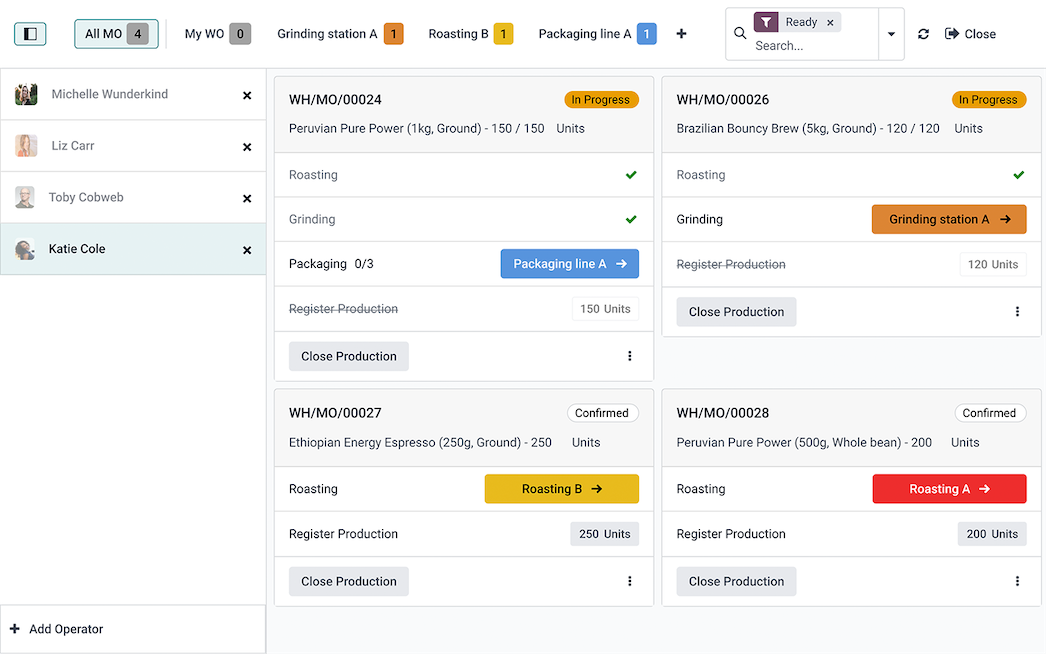
Operators receive instructions and record progress, material consumption, and work time straight from a tablet at the work station, cutting paper and double entry.
Trace material batches through to finished goods and back, giving full traceability for warranty, recalls, and industry compliance.
Manage outsourced processes — send materials, track progress, and compute subcontract cost — within the same flow as internal production.
Manage BOM versions and engineering change orders in a controlled way, so every component change is documented and doesn't cause production errors.
See each work center's load and schedule production to avoid bottlenecks, balance capacity, and meet deadlines more realistically.
Monitor efficiency, on-time rates, defect rates, and costs through real-time reports, so continuous improvement rests on data, not gut feel.
Odoo unifies production planning, execution, and recording in one connected flow — so a change at one point is immediately reflected at another. When an order grows, its material needs are recomputed, procurement is proposed, and the schedule adjusts with no manual spreadsheet rework. Here is a product's journey, from BOM design to finished goods entering stock with their actual costs, all tailored to your process, capacity, and shop floor.
Build the Bill of Materials complete with components, operations, and the work centers involved. This structure underpins planning, costing, and execution.
Based on orders and forecasts, Odoo computes material and capacity needs, accounting for existing stock and supplier lead times.
The system proposes purchasing or producing missing components automatically, so materials are available on time with no emergency orders.
A manufacturing order is created with reserved materials and clear work stages, ready to schedule to the right work stations.
Each stage is scheduled to a work center considering capacity and sequence, so bottlenecks can be avoided from the start.
Operators run work orders via the tablet app, recording progress, material consumption, and work time in real time with no paper.
Quality checkpoints run against criteria at the defined stages, holding problem products before they continue or ship.
Completed products enter stock automatically, materials are consumed, and all material, labor, and machine costs are recorded for accurate costing.
Reports show efficiency, on-time rate, and cost per order, forming the basis for continuous improvement in the next production cycle.
This page centers on the Manufacturing app, but production never stands alone — it depends on material stock, purchasing, quality, and cost recording. Every manufacturing order pulls materials from the warehouse, triggers procurement when short, and posts finished goods and their costs back to stock and the books. Because everything lives in one Odoo database, data flows seamlessly with no costly, fragile cross-system integration, and you can start with the production core then add other modules as needs grow with no re-migration. Here are the apps we most often implement together with Manufacturing to form a complete production operation.
The production core: BOMs, manufacturing orders, work orders, work centers, planning, and cost tracking.
Manages material and finished-goods stock, reserves components for production, and updates inventory automatically.
Procures raw materials automatically from MRP output, ensuring components are available on time.
Runs quality control points at receiving and during production, holding problem products before they continue.
Manages preventive maintenance and machine repairs so production isn't halted by sudden breakdowns.
Manages BOM versions and engineering change orders in a controlled way for documented product changes.
Receives accurate cost of production and inventory value straight into the books, with no manual calculation.
Triggers make-to-order production and gives more realistic time estimates to customers.
Real-time production reports and KPIs — efficiency, cost, and on-time rate — for operators to management.
Illustrative: a mid-sized manufacturer with tiered BOMs and many variants
A mid-sized manufacturer ran production planning in spreadsheets separated from stock and purchasing. Every time an order changed, the team had to recompute material needs by hand, and often only realized materials were short once production was already due. Production cost was guessed because material consumption and work time weren't recorded per order, so each product's margin was unclear. Shop-floor progress was known only by asking directly, machines occasionally broke down without warning, and tracing a material batch during a quality complaint was nearly impossible.
We implemented Odoo Manufacturing connected to Inventory, Purchase, and Quality. Multi-level BOMs were set up cleanly, MRP computes material needs automatically and proposes timely purchasing, and each manufacturing order schedules work orders to the right work centers. Operators record progress and consumption via a tablet app, quality checkpoints are placed at critical stages, and lot tracking is applied from materials to finished goods. Actual costs are now recorded per order so cost of production is real, and machine maintenance is scheduled to reduce sudden breakdowns.
Some of the questions prospective clients ask us most about implementing the Odoo Manufacturing module — from multi-level BOMs and material planning (MRP) to subcontracting, traceability, and cost and quality tracking. If yours isn't answered here, our team is happy to help via a free, no-obligation consultation.
Yes. Odoo supports multi-level BOMs, where a component can itself be an assembly with its own BOM. The system handles assemblies within assemblies, complete with operations and by-products, without losing clarity.
Odoo accounts for orders, forecasts, existing stock, and supplier lead times to compute what to buy or produce and when. Purchase or production proposals are created automatically, preventing both shortages and excess.
Yes. Material, labor, and machine costs are recorded per manufacturing order and compared against standard cost. Cost of production and each product's margin are therefore always real, not guessed.
Yes. Odoo provides a tablet-based shop-floor app where operators receive instructions and record work time, material consumption, and work-order progress in real time with no paper.
Yes. Odoo supports subcontracting, where you send materials to a third party, track progress, and record subcontract cost within the same flow as internal production.
You can insert quality control points at material receiving, during production, or at the end, with clear instructions and criteria. Problem products are held before they continue or ship to the customer.
Yes. Because Manufacturing is unified with Inventory, material consumption and output update stock in real time, so inventory balance and value always stay accurate.
Yes. With lot and serial tracking, you can trace a material batch to whichever finished goods used it, and vice versa — essential for warranty, recalls, and compliance.
Yes. The Maintenance module enables preventive maintenance scheduling and repair-request handling, so sudden breakdowns drop and production is halted less often.
Odoo shows each work center's load so you can schedule production to avoid bottlenecks. Capacity and sequence are accounted for so deadlines are more realistic and resources balanced.
Both. Odoo can trigger production from customer orders (make-to-order) or from minimum stock points (make-to-stock), and even combine the two depending on your product type.
Through PLM and engineering change orders, component or process changes are managed in a controlled, documented way, so the BOM version in use is always clear and doesn't cause production errors.
Yes. We help migrate master data such as products, BOMs, and work centers from your old system or spreadsheets into Odoo, so you start on a complete, tidy foundation.
Yes. Dashboards show efficiency, on-time rate, defect rate, and cost in real time, so management can decide on current data rather than a stale report.
No. The shop-floor app is designed to be simple for operators, while planners and managers get more complete tools. We provide role-based training and support until the team is comfortable.
Our estimate covers both implementation services and the Odoo license for your number of users, with no hidden fees. We explain the breakdown up front so you can budget with certainty.
It depends on product, BOM, and integration complexity. Manufacturing is generally more complex than other modules, and after an initial analysis we provide a clear, phased timeline so the transition stays controlled.
As an Odoo Gold Partner, we map your production process, set up the right BOMs and workflows, configure MRP and quality, migrate data, train both shop-floor and planning teams, and support you after go-live so the system is genuinely used.
Both. Odoo can handle discrete product assembly as well as batch production with by-products, making it flexible for industries like component manufacturing, food and beverage, chemicals, and packaging.
Odoo BOMs can define by-products so a process's secondary output is still recorded and valued. Scrap can also be logged as its own stock movement for accurate costing.
Yes. Odoo supports multiple production locations and warehouses in one system, so you can plan, run, and monitor production across several factories with data kept centralized.
Yes. Because Manufacturing is unified with Sales and planning, product availability dates are computed from capacity and material availability, so customer estimates are more realistic and trustworthy.
Odoo provides role-based access control, so operators, planners, and managers only see and do what they're responsible for. Activity trails are also recorded for transparency and audit.
Yes. With accurate BOMs, consumption recorded per order, and analysis of actual versus standard, material waste becomes visible and actionable — driving measurable efficiency gains.
Get a free consultation for your needs. We'll help map out the right modules and give you a clear cost estimate — no commitment.