
System stock differs from the physical count
Recorded numbers don't match the goods on the shelf because movements aren't always logged on time. This gap drives wrong decisions and steadily erodes trust in the data.
 Integrated Odoo Module
Accurate stock, in every warehouse, in real time.
Manage inventory with precision — multi-warehouse, lot and serial tracking, and automated reordering — all connected in real time. Because stock is unified with sales, purchasing, and accounting, the numbers you see always reflect what is truly on the shelf, not a stale guess. The result: teams stop guessing and start planning — cutting stockouts, freeing up trapped capital, and speeding up every warehouse operation.
The warehouse is where a company's capital takes physical form — and also where leaks most often go unnoticed. When stock is tracked on stock cards or spreadsheets, the system numbers and the goods on the shelf slowly drift apart: something is forgotten, miscounted, or moved between warehouses without a document. As a result, sales promises goods that turn out to be sold out, purchasing reorders items that are actually piling up, and every stock count becomes a long drama that forces the warehouse to stop working. The more SKUs, warehouses, and sales channels there are, the bigger the discrepancies and the hidden costs behind them. Here are the problems we most often see before a company tidies up its warehouse in Odoo.
Recorded numbers don't match the goods on the shelf because movements aren't always logged on time. This gap drives wrong decisions and steadily erodes trust in the data.
Without clear reorder points, fast movers suddenly run out and sales are lost, while slow movers pile up and lock away capital that should be turning over.
Counting an entire warehouse by hand takes days and often forces operations to halt. The result goes stale as soon as transactions resume.
Without lot and expiry tracking, old stock piles up at the back and is only discovered when it's no longer sellable — an entirely preventable loss.
Goods move between warehouses or branches without tidy documents, so no one knows for sure where stock is and how much sits at each location.
When a complaint arises or a recall is needed, tracing one batch from supplier to customer is nearly impossible, making the response slow and risky.
Purchasing only moves after goods are truly gone, triggering emergency orders, costly shipping, and customers waiting longer than they should.
Without location guidance and barcode verification, staff wander the warehouse and occasionally grab the wrong item, slowing shipping and causing returns.
Because stock isn't connected to the books, inventory value and cost of goods sold are only estimates. Financial reports drift from reality as a result.
Selling on marketplaces and in a physical store at once, with stock not centralized, means the same item gets sold twice, triggering cancellations and disappointed customers.
Owned goods, consigned goods, and items shipped directly from suppliers get mixed together without clear separation, throwing off both stock counts and costing.
Odoo Inventory runs the warehouse on a document-based (double-entry) movement system as precise as accounting: every item that comes in, goes out, or moves always leaves a trace. Stock updates in real time across every warehouse and rack location, and because it's connected to Sales, Purchase, and Accounting, there's no more cross-department mismatch or drifting inventory value. Reordering runs automatically on the rules you set, barcode speeds up every warehouse operation, and lot and serial tracking give full traceability from supplier to customer. Instead of fighting fires caused by discrepancies and stockouts, your team shifts to planned, data-driven management. Here are the core capabilities.
Track stock per warehouse, zone, and rack location down to the smallest detail. Transfers between locations are neatly recorded, so you always know exactly where each item is and how much you have.
Trace the origin and movement of every item by lot or serial number for full traceability — essential for warranties, recalls, and compliance in regulated industries.
Speed up receiving, transfers, picking, and stock counts with barcode scanning on mobile devices. Automatic verification cuts mis-picks and mis-ships significantly.
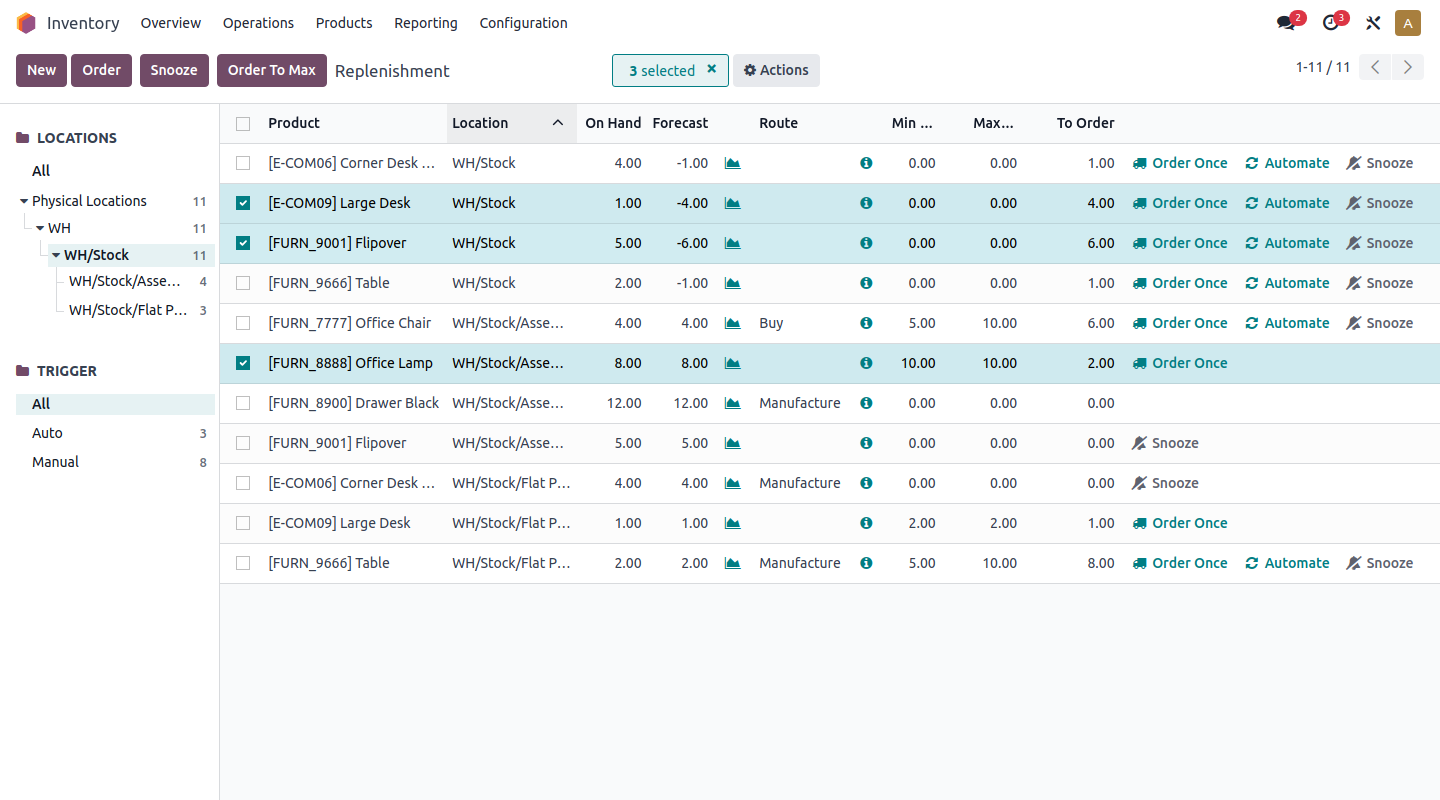
Set min-max reorder points or make-to-order strategies, and let Odoo automatically raise purchase or manufacturing proposals when stock runs low — before you run out.
Inventory value is computed automatically (FIFO, average, or standard cost) and flows straight into accounting journals, so cost of goods sold and the balance sheet stay accurate.
Manage inbound and outbound logistics with multi-step routes — receipt, quality control, putaway, and delivery — that can be tailored to your warehouse process.
Automate placing goods in the right location and the pick sequence based on FIFO or FEFO, maximizing space and keeping older stock moving out first.
Stock is automatically reserved for incoming orders, so the same item isn't promised to two customers, and the team knows exactly what's available to sell.
Manage expiry dates and ensure the first-to-expire goods leave first, with early warnings to reduce losses from spoiled product.
Ship goods straight from supplier to customer without holding stock, or route incoming goods directly to outbound shipping to speed up turnover.
Manage packages, pallets, and shipping weights, print labels and delivery documents, and integrate with carriers for a faster, tidier dispatch.
Monitor turnover rates, ABC analysis, dead stock, and demand forecasts through real-time reports and dashboards, so procurement decisions rest on solid data.
Odoo treats every stock movement like a transaction that must balance — goods never appear or disappear without a document. This is what keeps stock accurate even with hundreds of daily transactions, because no step can be quietly skipped. Each stage can also be tightened or simplified to fit: a small warehouse can use a lean flow, while a large one can add quality control, multi-step putaway, and double verification. Here is a product's journey through the warehouse, from arriving at the receiving dock to reaching the customer, which we tailor entirely to your layout, zones, and warehouse strategy.
Incoming goods are matched to the purchase order via barcode, quality-checked where needed, and added to stock the moment they're received — with no double entry.
The system guides staff to place goods in the right rack location based on putaway rules, maximizing space and making later picking easier.
Every unit is tracked by location, lot, and serial. Inventory value updates automatically and flows to accounting, keeping stock and finance in sync.
When stock hits its minimum, Odoo raises a purchase proposal or production order automatically, so fast movers are replenished before they run out.
As soon as a sales order arrives, the needed stock is automatically reserved and allocated, ensuring no item is promised twice.
Staff are guided to pick goods via the mobile app with an efficient route and barcode verification, cutting time and picking errors.
Goods are packed, weighed, and verified against the order before shipping, so customers receive exactly what they ordered.
Labels and shipping documents are printed, stock decreases automatically, and status is shared with customers and sales in real time.
Scheduled cycle counts allow rolling counts without stopping operations, sustaining stock accuracy continuously rather than once a year.
This page centers on the Inventory app, but a warehouse never stands alone — it's where purchasing, sales, manufacturing, and finance meet. Every time goods move, the effect is felt immediately in what's available to sell, the inventory value in the books, and the next procurement need. Because everything lives in one Odoo database, stock data flows seamlessly with no costly, fragile cross-system integration, and you can start with what's most pressing then add other modules as needs grow. Here are the apps we most often implement together with Inventory to form a complete supply chain.
The core of warehouse management: stock movements, multi-location, lot/serial, valuation, routes, and reorder rules.
A scanning app for fast, low-error receiving, transfers, picking, and stock counts on the floor.
Raises purchase orders automatically from reorder rules and records goods receipts straight into stock.
Gives stock visibility while selling, reserves goods for orders, and triggers delivery from the warehouse.
For producers, consumes raw materials and adds finished goods to stock automatically from production orders.
Receives accurate inventory value and cost of goods sold (COGS) straight into the journals, with no manual calculation.
Runs quality control points at receiving or production, holding problem goods before they enter stock.
Syncs online and offline stock into one source, so cross-channel sales no longer clash.
Real-time stock reports and KPIs that can be customized per role, from warehouse staff to management.
Illustrative: an FMCG distributor with 3 warehouses and hundreds of SKUs
An FMCG distributor managed three warehouses with hundreds of SKUs using stock cards and separate spreadsheets at each location. System stock almost always differed from the physical count, so sales often promised goods that were sold out, while another warehouse overstocked the very same item. Stock counts were done once a month and forced warehouses to close for a day, yet the numbers quickly drifted again. Goods nearing expiry were often discovered only when no longer sellable, and no one could trace a batch from supplier to customer when a complaint arose.
We implemented Odoo Inventory with three warehouses, rack locations, and lot tracking complete with expiry dates. Barcode was rolled out for receiving, transfers, picking, and cycle counts, so counting runs in rolling batches without closing the warehouse. Automatic reorder rules were set per product and per warehouse so procurement is no longer reactive, and stock was connected to Sales and Accounting so valuation and availability stay accurate. Initial data and stock balances were migrated, the warehouse team was trained on the mobile app, and we supported them until the new process ran smoothly.
Some of the questions prospective clients ask us most about implementing Odoo Inventory & Warehouse — from multi-warehouse, barcode, and lot tracking to integration with online sales and accounting. If yours isn't answered here, our team is happy to help via a free, no-obligation consultation.
Yes. Odoo supports multiple warehouses, zones, and rack locations in one system, with neatly recorded inter-location transfers. You always know how much stock is at each location and can move it with clear documents.
You can set reorder points per product and per warehouse. When stock hits the minimum, Odoo automatically raises a purchase or production proposal, so goods are replenished before they run out and sales aren't lost.
Yes. Every item can be tracked by lot or serial number, and expiry dates are managed with a FEFO strategy so first-to-expire goods leave first — essential for food, pharma, and warrantied goods.
Not necessarily. The Odoo Barcode app runs on Android smartphones or tablets, or with dedicated scanners for high volumes. We help pick devices that fit your needs and budget.
Yes. Because Inventory is unified with Odoo eCommerce and POS, the same stock is used across channels. An item sold online immediately reduces the same stock for the physical store, preventing double sales.
Odoo supports scheduled cycle counts — counting part of the stock in rolling batches. This sustains accuracy continuously without closing the warehouse for one big count a year.
Yes. Odoo computes stock valuation (FIFO, average, or standard) and flows it straight into accounting journals, so cost of goods sold and the balance sheet stay accurate with no manual work.
Yes. Odoo can separate owned stock from consigned goods and ship items directly from supplier to customer (dropship) without first storing them in your warehouse.
Yes. We help migrate product masters and opening stock balances from your old system or spreadsheets into Odoo, so you start with complete, accurate data rather than from zero.
Yes. Odoo can integrate with various carriers to print labels, calculate rates, and track shipments, making dispatch faster and cutting data-entry errors.
Through turnover reports and ABC analysis, you can spot slow-moving products earlier and act — promotions, returns, or adjusted purchasing — before capital sits idle too long.
No. The Odoo warehouse app is simple and scan-based, so it's easy for floor staff to learn. We provide role-based training and support until the team is comfortable.
Yes. You can control who may view, move, or adjust stock, and even restrict access per warehouse, keeping data secure and responsibilities clear.
Our estimate covers both implementation services and the Odoo license for your number of users, with no hidden fees. We explain the breakdown up front so you can budget with certainty.
It depends on the number of warehouses, SKUs, and integrations. After an initial analysis, we provide a clear, measurable timeline so you know when the system will be fully ready.
As an Odoo Gold Partner, we map your warehouse flow, design the right locations and rules, roll out barcode, migrate data, train the team, and support you after go-live so the system is genuinely used and accurate.
Yes. Odoo manages product variants such as size and color under one template, with separate stock, price, and barcode per variant. This makes large catalogs easy to manage without creating hundreds of separate, hard-to-maintain products.
Returns from customers or to suppliers are recorded as their own stock movements, and damaged goods can be moved to a dedicated location for processing. Everything is logged so inventory value and traceability stay accurate.
Yes. Odoo supports landed costs, so costs like freight, duties, and insurance can be added to goods value. Cost of goods then reflects the true cost, not just the purchase price.
Yes. You can buy in one unit (e.g. cartons) and sell or store in another (e.g. pieces), with automatic conversion. This matters for distributors and wholesale businesses.
Yes. Odoo can manage stock allocated to a specific project, contract, or customer via dedicated locations and rules, so already-committed goods aren't used for something else.
Yes. Odoo is web- and mobile-based, so stock position, reports, and dashboards can be accessed anytime from the office, warehouse, or on the go, given an internet connection and the right access rights.
Odoo provides planning tools that consider sales history, open orders, and supplier lead times to suggest when and how much to order. Procurement becomes proactive rather than merely reacting once stock runs out.
Yes. With serial-number tracking, each unit can be traced to the customer along with its warranty period, and when combined with related modules, service requests and spare parts can also be managed in the same system.
Get a free consultation for your needs. We'll help map out the right modules and give you a clear cost estimate — no commitment.