
Employee data scattered and messy
Personal information, contracts, and documents live across many files and folders. Finding one record takes time, and differing versions make any recap impossible to fully trust.
 Integrated Odoo Module
Manage employees from recruitment through payroll.
Unify your entire HR process — employee data, attendance, leave, reimbursements, recruitment, and payroll — in one integrated system. Because attendance, leave, and overtime flow straight into payroll, and payroll costs post automatically to accounting, HR administration becomes far leaner, more accurate, and more transparent for employees and management alike. And the HR team gets more time for what truly matters: caring for and developing people.
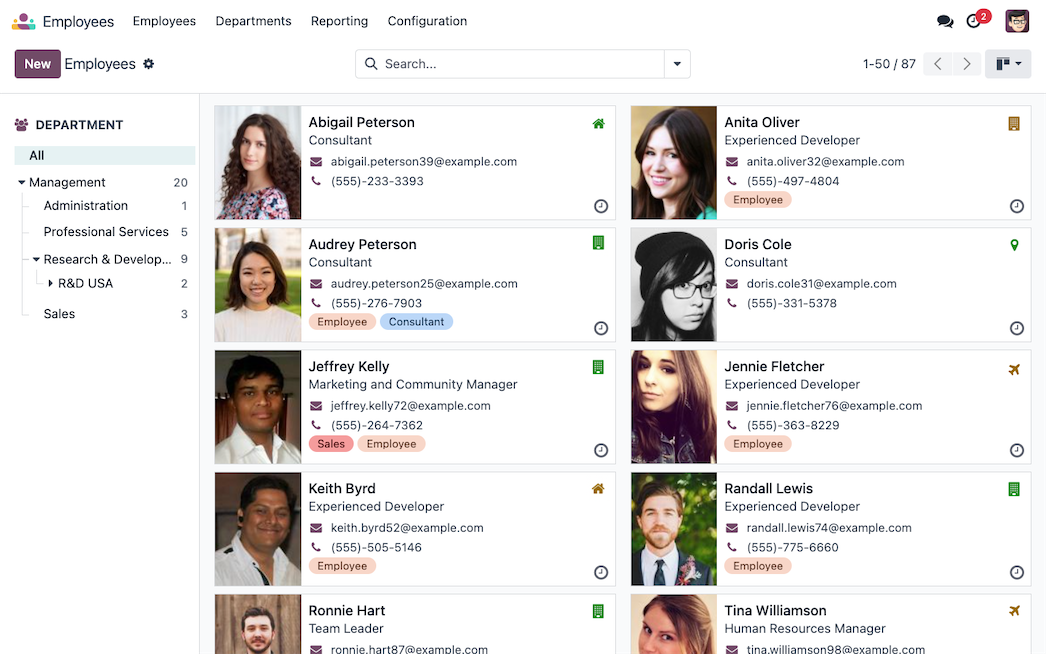
As a company grows, managing people that once fit in a single Excel file starts to buckle. Data spreads across many folders, attendance is recapped by hand from fingerprint machines, leave requests bounce around in chat, and every month-end the HR team races the clock to compute salaries, tax, and deductions with no room for error. One small payroll mistake isn't just a number — it directly touches employee trust and morale. Meanwhile, employees themselves can't easily check remaining leave or download a payslip without asking HR. As headcount grows and labor rules get more complex, the manual approach becomes slow, error-prone, and a drain on time that should go into developing people. What often goes unnoticed is that messy HR admin also hurts retention: employees who feel their data isn't managed well, whose pay is often wrong, or whose leave is hard to arrange, slowly lose trust in the company. Tidying up HR isn't just about efficiency — it's about keeping your best people happy. Here are the problems we most often see before a company tidies up its HR in Odoo.
Personal information, contracts, and documents live across many files and folders. Finding one record takes time, and differing versions make any recap impossible to fully trust.
Attendance is recapped by hand from machines or notes, which is slow and open to manipulation. Linking it to payroll and overtime becomes an exhausting extra chore every month.
Requests via chat or paper make leave balances hard to monitor, approvals go unrecorded, and disputes over who is entitled to how many days keep cropping up.
Computing salary, allowances, overtime, and deductions in a spreadsheet is complex and error-prone. One wrong formula can affect many employees at once, unnoticed until someone complains.
Calculating income tax and social-security contributions by hand against ever-changing rules eats time and risks errors, with serious compliance consequences.
Creating and handing out payslips one by one takes time, and employees often wait or must ask HR just to see their salary breakdown.
Applications arrive through various channels and get scattered, selection stages aren't tracked, and promising candidates slip away for lack of one place to manage them.
Each new hire gets a different orientation experience depending on who handles it, so documents, access, and initial training are often incomplete.
Appraisals are done haphazardly or not at all, with no clear data or goals, so employee development is hard to direct and feels subjective.
For simple things like checking leave, downloading a payslip, or updating data, employees must ask HR — adding administrative load that could be avoided.
When salary and allowance costs don't post automatically to the books, finance re-records them by hand, causing discrepancies and duplicate work every pay period.
Odoo HR unifies the entire employee lifecycle — from recruitment, onboarding, data and contracts, attendance, leave, and reimbursements, to payroll and performance appraisal — in one system. Attendance, overtime, and leave flow automatically into payroll, so pay runs are faster and more accurate, while salary costs post straight to accounting with no double entry. Employees get a self-service portal to request leave, download payslips, and update their data, reducing HR's administrative load. Payroll rules, including components like income tax and social security, can be configured and tailored to your company's policies and the applicable regulations. Instead of endless recapping and calculation, the HR team shifts to a more strategic role: developing people. Just as important, the system grows with your company: start from employee data and attendance, then add payroll, recruitment, and performance appraisal without switching platforms or re-migrating data. Here are the core capabilities.
Centralize all personal data, documents, contracts, and history in one secure, searchable place, complete with a clear organizational structure.
Log attendance via mobile app, kiosk, or biometric device, and link it directly to overtime and payroll with no manual recap.
Employees request leave online, managers approve in one click, and balances are computed automatically and transparently for everyone.
Compute salary, allowances, overtime, and deductions automatically from a configured salary structure, making monthly payroll fast, consistent, and low-error.
Income-tax and social-security components can be configured and tailored to the applicable rules, making calculation tidier and reporting prep easier.
Manage openings, gather and screen candidates in one pipeline, then run structured onboarding so new hires are ready to work sooner.
Employees can view leave balances, download payslips, update data, and submit their own requests, significantly reducing the HR team's admin load.
Build work schedules and shifts, manage different work patterns across teams, and ensure attendance is computed against the applicable schedule.
Employees submit expense claims with proof, managers approve, and costs post to the books once approved.
Run structured appraisals with clear goals and periods, so employee development is directed and data-based rather than impressionistic.
Map employee skills, spot competency gaps, and plan the right training to support team and company growth.
Monitor headcount, attendance rates, turnover, and HR costs through real-time reports, supporting data-driven management decisions.
Odoo connects the whole employee journey in one linked flow — so data captured at one stage is reused at the next with no re-entry. Applicant data becomes employee data, attendance becomes the basis for pay, and salary cost becomes a financial record, all without retyping. Here is the employee lifecycle inside the system, from recruitment to performance appraisal, all tailored to your structure, policies, and the payroll rules that apply at your company.
Openings are published, applications land in one pipeline, and candidates are screened in stages. Selected candidates' data is reused with no retyping when they become employees.
New hires go through structured onboarding, contracts are created, and documents and access are prepared, so they're ready to work quickly and consistently.
All personal information, contracts, and documents are stored securely in one place, becoming the single source for attendance, leave, and payroll.
Attendance is logged via app, kiosk, or biometric and linked directly to work schedules and overtime, with no month-end manual recap.
Employees request leave online, managers approve, balances are deducted automatically, and absences factor into payroll.
Expense claims are submitted with proof, approved by managers, then posted to the books and paid with salary or separately per policy.
The system computes pay from the salary structure, attendance, overtime, leave, allowances, and components like income tax and social security that have been configured.
Payslips are generated and shared automatically via the employee portal, salary costs post to accounting, and payment is prepared with no double recap.
Performance is reviewed periodically with clear goals, forming the basis for training, promotion, and employee development in the next period.
This page centers on the HR apps, but managing people touches many areas — attendance affects pay, pay affects finance, and reimbursements involve accounting. Odoo splits HR into several connected apps, so you can enable only what you need now and add the rest later. Because everything lives in one database, data flows seamlessly with no costly, fragile cross-system integration, and you can start with employee data and attendance then add payroll and other modules as needs grow with no re-migration. Here are the apps we most often implement together for complete HR.
The HR data core: employee profiles, contracts, org structure, and documents in one secure place.
Attendance capture via kiosk, app, or biometric, linked to work schedules and payroll.
Leave requests and approvals with automatic balances, connected to payroll and the team calendar.
Computation of salary, allowances, deductions, and components like income tax and social security, complete with payslips.
Manages openings and candidates in one pipeline, from application to becoming an employee.
Structured performance reviews with clear goals and periods for employee development.
Employee reimbursement requests and approvals that post to the books once approved.
Receives salary and allowance costs automatically from payroll, keeping finance in sync with HR.
Real-time HR reports and KPIs — headcount, attendance, turnover, and cost — for management.
Illustrative: a company of around 100 employees running payroll in Excel
A company of around 100 employees managed HR with a mix of Excel, fingerprint machines, and leave requests over chat. Every month-end, the HR team spent days pulling attendance data, matching it to overtime and leave, then computing salaries, income tax, and social security by hand — with high error risk and heavy time pressure. Payslips were made one by one, leave balances were a frequent source of dispute, and employees had no self-service way to check their data. Salary costs were also re-recorded manually by finance, causing discrepancies each period.
We implemented Odoo HR covering employee data, attendance, leave, and payroll, connected to Accounting. Attendance is now captured digitally and flows straight into payroll, leave is requested and approved online with automatic balances, and the salary structure plus income-tax and social-security components were configured to the company's policies. Payslips are shared automatically via the employee portal, salary costs post straight to the books, and employees can check their data and download payslips themselves. Legacy data was migrated, the HR team was trained, and we supported them until the new payroll process ran smoothly.
Some of the questions prospective clients ask us most about implementing the Odoo HR & Payroll module — from attendance, leave, and payroll to income tax, social security, and the employee portal. If yours isn't answered here, our team is happy to help via a free, no-obligation consultation.
Yes. Components like income tax and social-security (BPJS) contributions can be configured and tailored to the applicable rules and your company's policies. We help set up the salary structure and calculation rules so payroll is tidy and easy to report.
Yes. Odoo supports attendance capture via app, kiosk, or biometric device, and attendance data can be linked to overtime and payroll, so there's no need for manual recaps.
Through the self-service portal, employees request leave online, see their current balance, and track approval status. Managers approve in one click, and balances are deducted automatically.
Yes. Payslips are generated automatically from the payroll run and shared via the employee portal, so distribution is fast and employees can download them anytime without asking HR.
Yes. Because Payroll is unified with Accounting, salary, allowance, and deduction costs post automatically as journal entries, so finance stays in sync with HR without manual re-recording.
Yes. Odoo lets you build different schedules and shifts across teams or locations, and attendance is computed against each employee's applicable schedule.
Yes. We help migrate employee data, contracts, and important history from Excel or a legacy system into Odoo, so you start with a complete, tidy HR database.
Yes. Odoo Recruitment manages openings and candidates in one pipeline, from application to selection, and selected candidates' data can be used directly when they become employees with no re-entry.
Odoo Appraisals enables structured reviews with clear goals, periods, and forms, so employee development is directed and data-based rather than a passing impression.
Yes. Through the Expenses module, employees submit expense claims with proof, managers approve, and costs post to the books and can be paid per policy.
Odoo provides role-based access control, so only authorized parties can view sensitive data such as salaries. Data is stored centrally and securely, far safer than scattered files.
No. Odoo's interface is designed to be approachable for HR staff, and we provide role-based training plus concise documentation. Most teams are comfortable in a short time.
Yes. Odoo can manage employees across many branches, departments, and locations in one system, with org structure, schedules, and payroll kept centralized and consistent.
Our estimate covers both implementation services and the Odoo license for your number of users, with no hidden fees. We explain the breakdown up front so you can budget with certainty.
It depends on the complexity of the salary structure, attendance rules, and integrations. Payroll usually needs careful configuration, and after an initial analysis we provide a clear, phased timeline so the transition stays controlled.
As an Odoo Gold Partner, we map your HR process, set up the right salary structure and attendance rules, configure components like income tax and social security, migrate data, train the team, and support you after go-live so the system is genuinely used and accurate.
Yes. Odoo manages various contract types — permanent, fixed-term, and daily — with different salary structures and terms, so payroll for each group of employees stays accurate in one system.
Overtime can be computed from attendance data per the rules and rates you set, then automatically included in payroll. This eliminates manual recaps and reduces discrepancies in overtime pay.
Yes. Components like holiday allowance and bonuses can be configured as part of the salary structure or run as a special payroll, so calculations are consistent and neatly recorded.
Yes. Employee loans or advances can be recorded and their deductions scheduled automatically from each period's pay, so loan balances are always tracked and repayment runs orderly.
Yes. The payslip format and components can be tailored to your company's needs, so employees receive a clear breakdown aligned with your payroll policy.
Odoo sets access per role: employees see only their own data, managers see their team, and HR manages the whole. Sensitive data like salaries is visible only to authorized parties.
Yes. HR dashboards show headcount, attendance rates, turnover, and HR costs in real time, helping management understand trends and decide on data.
Yes. Being web- and mobile-based, employees can log attendance, request leave, and access payslips from anywhere, so managing remote or hybrid teams stays tidy and transparent.
Odoo helps manage the exit stage — deactivating accounts and access, computing final entitlements, and archiving data — so offboarding is orderly, documented, and secure.
Get a free consultation for your needs. We'll help map out the right modules and give you a clear cost estimate — no commitment.