
Purchasing is manual and slow
Requests, quotes, and orders are handled via chat, email, and paper forms that easily go missing. The process is slow, hard to trace, and often holds up operations waiting on goods.
 Integrated Odoo Module
Procurement that's automatic, transparent, and under control.
Automate your purchasing process — from requests for quotation and vendor comparison to orders and bills — with clear cost control and approvals. Because purchasing is unified with stock, production, and accounting, every procurement starts from a real need and ends as an accurate financial record, with no discrepancies and no double entry.
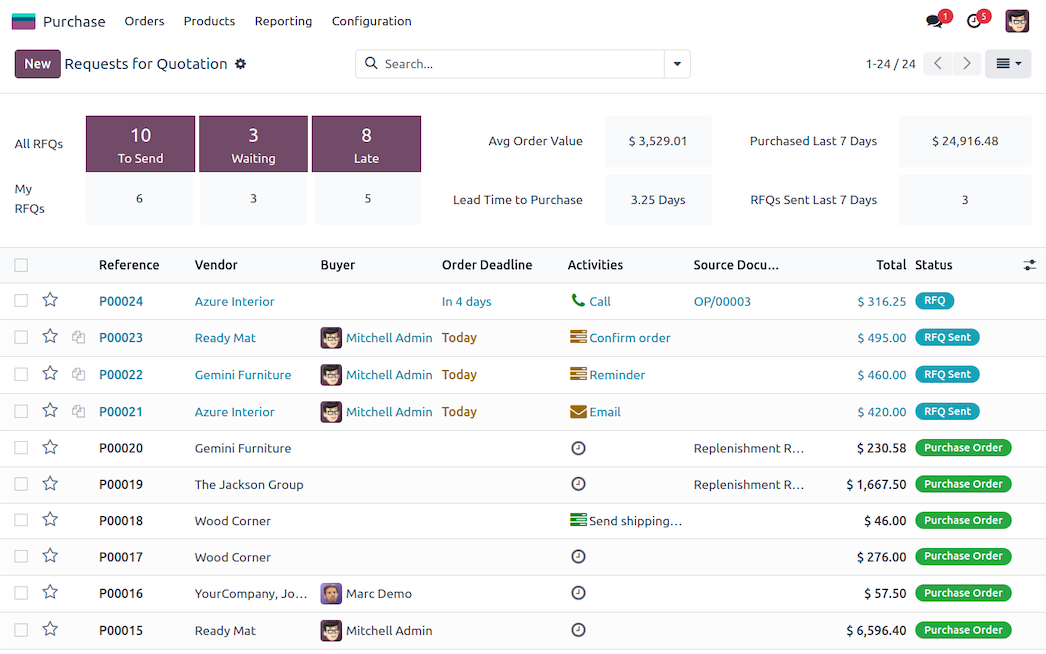
Procurement is where most of a company's money is spent — and precisely where control is most often loose. When purchasing still runs through chat, email, and paper forms, requests are hard to trace, approvals depend on whoever happens to be around, and vendor prices are never truly compared. As a result, the company pays more than it should, orders late so production or sales are disrupted, and discovers the gap between what was ordered, received, and billed only after the money is gone. Without a clean trail, leaks and waste are hard to prevent, and management has no clear view of where the budget actually flows. Because procurement absorbs the largest share of spending, saving even a few percent here impacts profit far more than chasing extra sales. But that opportunity is only within reach when the buying process is organized, measurable, and comparable. Here are the problems we most often see before a company tidies up its procurement in Odoo.
Requests, quotes, and orders are handled via chat, email, and paper forms that easily go missing. The process is slow, hard to trace, and often holds up operations waiting on goods.
Without a clear approval flow, purchases can happen without management's knowledge. Spending over budget is discovered only after the money is out and hard to claw back.
Because quotes aren't gathered and compared in a structured way, the company often pays more than the best price actually available in the market.
Without tidy matching, quantities or prices on the bill can differ from the order and the goods received. The company overpays without noticing.
Buying only moves after stock or materials truly run out, triggering emergency orders, costly shipping, and operations delayed while waiting.
Each supplier's pricing, contacts, and history are spread across many places. There's no basis to judge which vendor is most reliable, cheapest, and on time.
Without documentation of who requested, approved, and ordered what, audits become hard and the door to fraud opens wide — especially on large purchases.
Negotiated price agreements often go underused because they aren't recorded in the system, so buying happens outside the contract prices already agreed.
When procurement isn't connected to the warehouse and books, goods receipts and bills are re-entered by hand, causing discrepancies and duplicate work across departments.
Without centralized data, answering questions like spend by category or by vendor takes hours of manual recap, so savings opportunities are often missed.
Negotiations, revisions, and confirmations happen in personal chats and emails. When people change or forget, important context and commitments are lost with them.
Odoo Purchase turns procurement from a scattered process into a structured, transparent, and controlled flow. Purchase needs can arise automatically from stock rules or production planning, requests for quotation are sent to several vendors at once and compared side by side, and every order passes budget-appropriate approval before it's sent. When goods arrive, the receipt is matched to the order, and the bill is validated through three-way matching before payment — preventing overpayment. Because everything is unified with Inventory and Accounting, receipts immediately add to stock and bills post straight to the books, with no double entry. Management gets a clean trail and real-time spend analysis, so every rupiah spent is visible and under control. Just as important, the system grows with your business: start from simple procurement, then add budget control, a vendor portal, multi-company, and long-term contracts without switching platforms. All the controls are built in to keep spending discipline as your company scales. Here are the core capabilities.
Create requests for quotation and purchase orders quickly, send them straight to vendors by email, and track status from created to received in one place.
Manage each supplier's contact data, pricing, terms, and history in one place, complete with performance ratings based on timeliness, price, and quality.
POs are proposed automatically from minimum-stock rules, production planning (MRP), or sales orders, so procurement is proactive and no longer waits for a stockout.
Match the order, the goods received, and the bill automatically before payment, so quantity or price gaps are caught and the company doesn't overpay.
Gather quotes from several vendors for the same need and compare price, terms, and lead time side by side to choose the best option objectively.
Manage long-term price contracts and blanket orders, so recurring purchases automatically use the negotiated price with no re-negotiation.
Set approval rules by value or category, so large purchases need the right sign-off and spending stays within budget from the start.
Vendors can receive RFQs, submit quotes, and confirm orders through an online portal, cutting back-and-forth communication and speeding up the process.
Insert quality checks at goods receipt, so items that don't meet spec are held before entering stock or the production process.
Purchase in multiple currencies with automatic exchange rates, and manage procurement for several entities or branches in one centralized system.
Goods receipts immediately add to stock and vendor bills post automatically to the books, so inventory, payables, and costs stay accurate with no double entry.
Analyze spending by category, vendor, or period through real-time reports and dashboards, surfacing savings opportunities and keeping the budget under control.
Odoo unifies the whole procurement cycle in one controlled flow — from a need arising to a bill paid and recorded. Every step leaves a clear trail, so there's no purchase without approval and no bill without matching. The flow can be simplified for small routine purchases, or tightened with layered approvals for large spend — all following your policy. Here is a procurement's journey through the system, from the first need to vendor evaluation, all tailored to your company's budget and approval policy.
Needs arise automatically from minimum-stock rules, production planning, or sales orders, or from tidily recorded manual requests across departments.
RFQs are sent to one or several vendors at once straight from the system, complete with the products, quantities, and terms wanted.
Incoming quotes are compared side by side on price, terms, and lead time, so the decision is made objectively rather than by habit.
The order passes an approval flow by value and category. Large purchases are signed off by the right party before proceeding, keeping spending in budget.
Once approved, the PO is sent to the chosen vendor with clear terms, and its status is monitored until the goods arrive.
Arriving goods are matched to the PO and quality-checked where needed, then immediately add to stock on receipt.
The vendor bill is validated against the order and the goods received. Quantity or price gaps are caught before payment is approved.
Matched bills are passed for payment and post automatically to accounting as payables and costs, with no re-entry.
Vendor performance is updated, and spend reports show where the budget flows, forming the basis for the next negotiation and savings.
This page centers on the Purchase app, but procurement never stands alone — it's triggered by stock and production needs and ends as a record in finance. Every received PO adds to stock, and every matched bill posts straight as a payable and cost, with not a single number typed twice. Because everything lives in one Odoo database, data flows seamlessly with no costly, fragile cross-system integration, and you can start with the purchasing core then add other modules as needs grow with no re-migration. Here are the apps we most often implement together with Purchase to form complete procurement.
The procurement core: RFQs, purchase orders, vendor management, price agreements, and purchase analysis.
Triggers automatic procurement from minimum-stock rules and records goods receipts straight into stock.
Receives vendor bills automatically from orders and receipts, recording payables and costs with no double entry.
Provides material needs from production planning (MRP), so purchasing aligns with the production schedule.
Triggers buying from customer orders (make-to-order) or dropship straight from vendor to customer.
Runs quality checks at goods receipt, holding non-conforming items before they enter stock.
E-signatures for contracts and purchase agreements, speeding up approvals with no print-and-scan.
Real-time spend and vendor-performance analysis, customizable to the indicators that matter to you.
Complements procurement with recording of operating costs and employee reimbursements that also post to the books.
Illustrative: a company with many vendors and procurement without budget control
A company ran procurement through chat and email, with no clear approval flow. Requests from various departments were hard to trace, and purchases were often made without comparing vendor prices, so the company frequently paid more than it should. Incoming bills didn't always match the goods received, but the gap was found only after payment. Vendor data was scattered, so there was no basis to judge who was most reliable, and management had no clear view of where the purchasing budget actually flowed each month.
We implemented Odoo Purchase connected to Inventory and Accounting. Needs now trigger RFQs to several vendors at once for comparison, and every order passes an approval flow by value and category before being sent. Three-way matching was applied so bills are paid only when they match the order and receipt. Vendor data and performance were centralized, price agreements were recorded so recurring purchases use the best price, and a spend dashboard gives management a real-time view of spending by category and vendor.
Some of the questions prospective clients ask us most about implementing the Odoo Purchasing module — from approval flows and three-way bill matching to vendor management, price contracts, and integration with stock and finance. If yours isn't answered here, our team is happy to help via a free, no-obligation consultation.
Yes. You can set approval rules by value or category, so purchases above a threshold must be signed off by the right party before being sent to the vendor. Every approval is recorded for transparency and audit.
Odoo automatically matches the purchase order, the goods received, and the vendor bill. If quantity or price don't match, the system flags it before payment, so the company doesn't pay more than it should.
Yes. POs can be proposed automatically from minimum-stock rules, production planning (MRP), or sales orders, so procurement is proactive and goods are replenished before they run out.
Yes. You can send RFQs to several vendors for the same need, then compare price, terms, and lead time side by side to choose the best offer objectively.
Each vendor's contact data, pricing, terms, and history are stored centrally, with performance ratings based on timeliness, price, and quality — making it easy to pick the most reliable supplier.
Yes. Goods receipts immediately add to stock, and vendor bills post automatically to the books as payables and costs, so inventory and finance stay accurate with no double entry.
Yes. Through purchase agreements and blanket orders, negotiated prices are stored in the system so recurring purchases automatically use the contract price with no re-negotiation.
Yes. Odoo can process purchases in multiple currencies with automatic exchange rates and gain/loss adjustments, ideal for companies importing materials or goods from abroad.
Yes. Vendors can receive RFQs, submit quotes, and confirm orders through an online portal, cutting back-and-forth email and speeding up the procurement process.
Through real-time reports and dashboards, you can analyze spend by category, vendor, or period, surfacing savings opportunities and keeping the budget under control with no manual recap.
Yes. Odoo supports multi-company and multi-branch, so each entity's procurement is managed in one system with data and reports kept centralized.
You can insert quality control points at receiving, so items that don't meet spec are held before entering stock or being used in production.
Yes. We help migrate vendor data, price catalogs, and important history from your old system or spreadsheets into Odoo, so you start on a complete foundation.
No. Odoo's interface is designed to be approachable for procurement staff, and we provide role-based training plus concise documentation. Most teams are comfortable within days.
With approval flows, three-way matching, and a complete audit trail, every purchase is documented from request to payment, so the door to fraud is far narrower and transparency is preserved.
Our estimate covers both implementation services and the Odoo license for your number of users, with no hidden fees. We explain the breakdown up front so you can budget with certainty.
It depends on the complexity of approval flows, the number of vendors, and integrations. After an initial analysis, we provide a clear, measurable timeline so you know when the system will be ready.
As an Odoo Gold Partner, we map your procurement process, design the right approval flows and budget controls, migrate vendor data, train the team, and support you after go-live so the system is genuinely used and delivers results.
Yes. Departments can submit purchase requests that are tidily recorded, then the procurement team turns them into RFQs or POs once approved. The whole flow from request to receipt is documented and easy to trace.
Non-conforming goods can be returned to the vendor as their own stock movement, with a return note and bill adjustment recorded. Inventory value and payables stay accurate after the return.
Yes. Odoo supports landed costs, so costs like freight, duties, and insurance are added to goods value. Cost of goods reflects the true cost, not just the vendor's purchase price.
Yes. Price agreements and contracts can carry validity dates, and Odoo can surface or remind you of contracts nearing expiry, so re-negotiation happens on time with no supply gap.
Odoo records each vendor's timeliness, quantity accuracy, and price history, so you can judge suppliers objectively on data — not just impressions — when deciding who to order from next.
Yes. Odoo can record advance and installment payments to vendors and link them to the final bill, so payable position and cash flow to suppliers stay accurate at every stage.
Yes. All purchase reports and analyses can be exported to spreadsheet or PDF for meetings, audits, or further reporting, with no need to rebuild the data by hand.
Get a free consultation for your needs. We'll help map out the right modules and give you a clear cost estimate — no commitment.